Just tracked this down this week... 3 months after the course. It's spring in welly and I'm wearing more layers than I was in a Brissy "winter".
I've been rather busy, but it must be time to do some course reflections...
Monday, September 21, 2015
Thursday, July 16, 2015
"We don't own the land, the land owns us"
An Aboriginal (wish I'd written down what part of the country they were from...) performance at NAIDOC (National Aborigines and Islanders Day Observance Committee’ - though these days NAIDOC refers to the week long festival) festival in Musgrove Park.
Monday, July 13, 2015
Home time
All good/intense things must come to an end...
Saturday was our last day. In the morning was Project Hope, a series of 6 weekly talks put on by Waiters Union for people who aren't necessarily connected to WU events or living nearby. This one was about West Papua and Jason MacLeod's (Peast activist and academic at UQ) life experiences doing peace work there. It had some pretty raw stories to tell. In fact, the stories that really stood out were about his own marriage and the challenges of having a sense of a life mission along way from family and home. More of us singles could do with hearing the non glory stories of marriage! Yikes.
After that we packed up and here's a picture of all of us, minus yours truly having our last lunch together.
West End, Canberra, Melbourne, Welly, Melbourne, Gold Coast, Gold Coast, West End, an hour south of Melbourne on the Mornington peninsula (we introduced ourselves a lot of times over two weeks!) :p
Saturday was our last day. In the morning was Project Hope, a series of 6 weekly talks put on by Waiters Union for people who aren't necessarily connected to WU events or living nearby. This one was about West Papua and Jason MacLeod's (Peast activist and academic at UQ) life experiences doing peace work there. It had some pretty raw stories to tell. In fact, the stories that really stood out were about his own marriage and the challenges of having a sense of a life mission along way from family and home. More of us singles could do with hearing the non glory stories of marriage! Yikes.
After that we packed up and here's a picture of all of us, minus yours truly having our last lunch together.
West End, Canberra, Melbourne, Welly, Melbourne, Gold Coast, Gold Coast, West End, an hour south of Melbourne on the Mornington peninsula (we introduced ourselves a lot of times over two weeks!) :p
Sunday, July 12, 2015
Creative Inquiry
Ruby Andrews (Dave’s daughter - helped look after Peoples Coffee roastery while Matt was away in 2005) took us through a creative inquiry (aka art therapy). She's currently using this process with a group of school principals. This was a really great process, described over on her Kush Consulting website:
Finding ways to externalise experiences by giving them form and together making sense of what we see. At Kush we believe that the client has the answers and that they are embodied within their senses and need only to be drawn out, given qualities and form so they can be the truth tellers.
It ended up being quite an amazing approach for getting us connecting with our creative/emotional side. Perhaps the fact we're away from our normal context, responsibilities and hang ups helps as well. At the very end, some how, (it seemed like an accident but Ruby knew what she was doing!) we condensed all our efforts down to a few words that resonated. Once we had our words, turning them in to a poem was a whole lot easier than I expected!
My poem:
This process is like black magic,
Solidarity for loss of identity.
Where did that come from?
Where will it go to?
Guidance, alongside, leading to a sense of belonging.
Saturday, July 11, 2015
Cost sharing
In a cost sharing workshop this week, we killed two birds with one stone.
- Introduction to a collaborative way of sharing costs, and
- Pay for the course
We started off with some exercises to get us collaborating and organising in general. Then there was a fun creative process for helping us to reduce the sense of power money has.
We then got in to small groups to talk about our family background with money and any financial responsibilities we have.
After that each group discussed amongst themselves how much they thought the course cost the organisers / and how much they thought they could afford. We took those group figures back to the whole group and added it up. Then the organisers put up the actual amount. Our combined amount was $400 higher. Pretty close!!
We went away and reviewed our amounts based on what we’d come back with and got even closer.
Outcome: The course is paid for based on what people felt they could pay while managing power and financial dynamics in a really healthy way. We also chose to assign the surplus we gave to improvements around the house.
Thoughts: I'll have to give this one a try some time!
Friday, July 10, 2015
Interactive reflection
Many morning's of the course we've done some kind of spiritual reflection, this morning it was with Mark Delaney from Servants. He's spent 18 years with his family living in Indian slums.
He took the Bible passage Luke 7:11-17, about Jesus healing a widow's son. He read through it once to refresh us then assigned all of us a role from the passage (via a pen spin, since no one wanted to be Jesus!), Jesus, Widow, Son, Crowd and Disciples. Then he re-read the passage but this time we were listening and imagining our self in that role.
It was a surprisingly powerful way to really get involved in the Bible. I haven't experienced something quite like it before. A couple of lines of black and white text turned into a full coloured story. Deep sorrow and loss both emotional, political and economical, deep compassion and power, doubt, questioning, surprise, pure and unadulterated delight and hope!
He took the Bible passage Luke 7:11-17, about Jesus healing a widow's son. He read through it once to refresh us then assigned all of us a role from the passage (via a pen spin, since no one wanted to be Jesus!), Jesus, Widow, Son, Crowd and Disciples. Then he re-read the passage but this time we were listening and imagining our self in that role.
It was a surprisingly powerful way to really get involved in the Bible. I haven't experienced something quite like it before. A couple of lines of black and white text turned into a full coloured story. Deep sorrow and loss both emotional, political and economical, deep compassion and power, doubt, questioning, surprise, pure and unadulterated delight and hope!
Inter-faith dialogue
We had a couple of hours to dialogue with a muslim friend of Dave’s...
Points of interest:
- Some of her friends have left Australia as they can’t handle the abuse any more, even though they grew up in Oz.
- She holds to some feminist ideals but doesn’t find the hijab oppressive as she has chosen to wear it. It has deep cultural value to her.
- Hijab’s represent Mother Mary’s purity. Head coverings were worn in many Christian circles until fairly recent times too.
- There’s no reference to original sin in the Koran, or to Eve being responsible (there’s equal blame).
- Some of the more oppressive things we see in the media are cultural not religious. For instance the Burkha isn't "Islamic" and she doesn't agree with it, however it did have some legitimate origins in the dessert to keep the sand out. In one north African country there is a tribe where male's still cover their faces.
- She deeply respects Dave as he is a friend and isn’t hell bent on trying to convert her. Christians’ who’s primary aim is to prove wrong or convert Muslims, do more harm than good (obviously!).
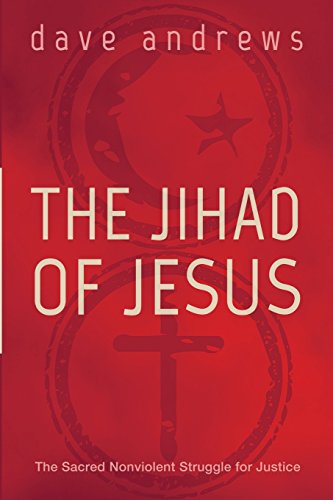
Dave’s book The Jihad of Jesus is a great read for unpacking some of the challenges between Christianity and Islam. Among other things he does a great job of unpacking the dark and light sides of both religions’ history's (I managed to speed read through most of it while it was hanging around here).
"Given continued distressing references to 'jihad' in newspaper, radio and tv headlines some of my friends, both Christian and Muslim, suggested I write a book about Jesus and 'jihad' and call it 'The Jihad of Jesus'. It was hoped the provocative title would get a lot of attention, and we could introduce Christians and Muslims to a Qur'anic reconstruction of the concept of 'jihad' in the light of the radical practical nonviolence of Jesus.
I have not written this book as an expert. I am not. I have not written this book as a specialist. I am not. I have simply written this book in conversation with Muslim friends, seeking to find a way we can struggle for love and justice that is true to the best in our faith traditions."
Thursday, July 09, 2015
Liberation theology
Charles Ringma gave us a run down on Liberation Theology.
Context: Liberation theology was developed by "footloose" theologians (they aren't working in institutions but are on the ground / at the coal face). Started in the 1960's when the developing world started forming it's own theology rather than using what the West had created in "ivory towers". So it's indigenous / grass roots theology.
They came at the Bible from a different perspective formed by their context. e.g. Where westerners tend to identify with the good Samaritan (though we should really identify with the priest or the Levite!). People that are living in poverty tend to identify with the victim.
2. New way of doing theology
- Start with praxis - Identify with the poor, work amongst them, then develop theology out of the reflections that come from that work. This is quite different to the western way, which has tended to be developed in libraries/ivory towers.
- The theology becomes a reflection of what theologians are doing in community/local context.
- Solidarity is found in a framework of action.
- Theology is invitational rather than authoritative - only the gospels should be authoritative.
- Theology is developed in a way that is more relevant for Africa, Asia and Latin America.
- Truth is not a razor edge, it’s a table top - there's room to move, for different interpretations. e.g. There's four gospels, not just one. Four different perspectives which can be interpreted in different ways depending on the context.
3. New way of being church
- Church OF the poor not church FOR the poor. In this type of church everyone is equal, no matter what their origins or economic situation.
- For those of us going in to liberation contexts, going as a learner rather than an expert is one of the most helpful things we can do.
4. New spirituality
- There's a need to be open to change, highly adaptive.
- Need to be sure the dominant culture isn't overly influencing.
- Often the call in the Bible is to the desert. The desert is a solitary place to reflect and contemplate, this allows us time to be open to change.
- Through contemplation in the desert, new insights on how to engage in the local context can be developed which helps us to become aware of the influence of the dominant culture and our own motivations. Without this we can go on charging, without reflecting on wether our action is appropriate or not.
- Often our western culture compartmentalise’s two different but important elements of spirituality:
- Movement of transcendence - Pray, Seek God, Read Scripture
- Movement of incarnation - engagement in the context, living amongst people, action/doing!
The two of these together become much more relevant and integrated.
5. New way of doing mission
- Annunciation: We are bearers of good news / hope. A powerful type of annunciation is to DO good things not just talk about them.
- Denunciation: A strong emphasis on prophecy. Jesus as prophet, priest and king. Liberation theologians emphasise the prophet side of Jesus. Prophet’s expose what is wrong by doing the opposite.
Thought for reflection:
"...show me what I am, and what Thou hast purposed me to be. Then hide me from Thy tears." - Hilda of Whitby (614-680)
- It’s better to have mixed motives and act, than sit on the shelf and do nothing.
- We are the wounded healer - Nouwen
Wednesday, July 08, 2015
Transforming the system
Transforming the system from was the third in a series of community frameworks' talks.
1. Be committed to transformation
- Romans says "do not conform..." but it also says, "be subject to authorities". One practical way to read this contrast is to compromise as much as you can, without compromising on your commitment to transformation.
2. Prepare for engagement
- Find a sponsor higher in the system than you. Jesus had Nicodemus and Joseph of Arimathea, life would've been a lot trickier otherwise.
- Join a movement, don’t go off and start your own thing unnecessarily - Jesus joined John the Baptist’s movement. i.e. Work with the people already there.
- Get a couple of supporters - Jesus had Timothy, Titus, disciples etc. People to go on the journey with, to form community with.
3. Long term strategy
- Transform the system by transforming hierarchy to mutual relationship, one at a time.
4. Short term strategy
- The space for change is at the edge of the system. Jesus forbids us from moving up the system - “don’t take the head of the table”. ie. working up the hierarchy to get more influence, only reinforces the system.
- Experiment on the edge, when an opportunity arises, integrate back in but be prepared to wait a long, long time!
- Waiters' opportunity came when the Rector was going on sabbatical and needed someone to take the Sunday evening service. Due to relationships built up, there was enough trust to let them take the service while negotiating to do it in a very different way (breaking all but a couple of critical Anglican rules).
5. Pain of change
- Be prepared to return good for evil.
- There’s no pain free change (try being kicked out of 12 organisations!)
- People don’t change until the pain of change is less than the pain of staying the same.
Mental health day
Monday was an intensive introduction to all the challenges/opportunities that come with mental health (or lack of).
Some key reflections from session 1:
- A good approach to mental health needs to be holistic // physical, spiritual, emotional, communal etc.
- A sense of belonging and connectedness to people and place is essential.
- Recovery is possible, people aren’t always the same but they find new ways to cope and in some cases, harness their unique gifts.
- 12 step programme's (adopted from AA) have been really helpful for getting people on a road to recovery.
We were introduced to the UN's framework for an optimal mix of services in mental health:
The gist is, those empowered to look after themselves and with lots of interaction in informal community don't end up at the top of the pyramid which costs a lot and tends to be infrequent support.
In order to support people well, it's helpful to move away from diagnostic type labels. It's really important to use language that is inclusive and respectful. For instance:
- Bob is struggling with meaning in life, rather than he's suicidal.
- Jill occasionally hears voices, rather than she's schizophrenic.
This helps mental health challenges to become more of an everyday thing. Like physical health. e.g. Mike has broken his leg, rather than he's a cripple.
Session 2 - Hearing voices
We heard stories from people who hear voices and have been through the mental health system. They then took us through an intensive exercise. We wore iPods that played a constant series of voices that are stereo typical. There was no escaping them for one hour!
Go faster! Go slower. Stop touching yourself! You stink! Why are you doing that? What’s wrong with you? gibberish gibberish and more gibberish!
While the voice were playing we had psych tests, psych exercises, a “community visit” in to town to ask a question a shop keeper where the library was. All the while the voices are making it hard to concentrate and are very tiring! Filling out forms was a lot trickier.
When referring to people that have gone through the system, one of our tutors suggested "people first" language like:
- People who have lived experience
- People who have been diagnosed with a mental illness
- People who have experienced emotional anguish
- People who have been through the system
Key reflections for me:
- My mind is so peaceful in comparison!
- The mental health system can be incredibly dehumanising.
- Having friends and family who are understanding and not freaked out by mental illness makes a big difference.
Tuesday, July 07, 2015
Monday, July 06, 2015
Sunday - Day off!
It's time to chill, so I hire a bike and go for a ride along the river. Brissy has turned on the weather for me!
Saturday, July 04, 2015
Prayer
Each day we’ve been introduced to a different way to pray. Yesterdays style was intercession as empathetic prayer. Jesus empathises with peoples pain. This is a way of helping the sufferer connect with God. It goes something like this:
- Enter in to the sufferers pain.
- Identify in their language
We imagined a person in our lives who’s been suffering, then we spoke out loud what we imagined saying on their behalf, to God. With language that would suit them, trying not to use the “in” words.
For instance (real world example), a doctor (normally pretty conservative) has a patient who is a street worker visit him. She asks for his help as she’s “pretty fu*cked” and can’t handle the lifestyle anymore. He asks her if she minds if he prays for her. She says sure. He prays something like “Oh God, we’re fu*ked! Please help us”
Community dinner
After our trip to the farm it was off to St Andrews basement for the fortnightly community dinner. This week was a larger crowd as some of their Muslim friends brought dinner for everyone. It's Ramadan, and everyone gets excited when the Muslims bring food!
Catholic worker farm
We travelled an hour out of town to visit a Catholic worker farm today. I drove all 12 of us in a large van.
They manage to create their own hot water, electricity, bio-gas and bio fuel!
There's a stack of load of fruit trees (see the bananas in the background).
They managed to make the most of the visiting labour to spread the liquid waste from the bio-gas around the property.
And of course, it's a small world. One of their daughters has married a Land and lives in the Hokianga!
Friday, July 03, 2015
Trinity #2
In the model of the Trinity, hierarchy is subordinate to equality.
One way this is worked out in the Waiters Union is that the "expert is on tap, not on top".
Wednesday, July 01, 2015
The West End of Brisbane
The West End is effectively a peninsula created by the bends of the Brisbane river. It has a feel a little bit like Newtown, close to the city (30 to 40 min walk) but you don't need to go there.
Thomas Street is the house where the community course is based. It's an old house with quite a few rooms used as offices during the day by various different community organisations.
The Trinity
A divine model for community.
![]() |
| Rublev's Trinity |
The three persons of the trinity
are equals
demonstrate both genders
are sharing food
are inclusive by inviting the onlooker
One way way to refer to the three people in the trinity, which is language that can be used widely: Creator, Liberator, Inspirator.
Six community qualities modelled by the trinity
Creates a safe space
Accepts you for who you are now
Respects your similarities and differences
Treats you as special not expendable
You can participate in decisions that impact you
They're committed to justice, not just us
Following Jesus
Jesus calls two people to follow him. To one he says, leave home and follow me, to another he says return home to follow me. Two people called in opposite directions, towards Jesus. How can we know which one is following Jesus's call? We don't, all we can do is help each person to take their next step towards Jesus.
The pentecostal movement was originally focussed on people in poverty. To someone in poverty, helping them towards wealth, is helping them to take the next step towards Jesus. Encouraging that same direction for someone in wealth, may not help them towards Jesus. So it's really important that we each discern together and on our own what our next step is. Its different for everyone. What might be a step toward Jesus for one person, is a step away for another.
Monday, June 29, 2015
Inclusive decision making
How does an inclusive community with open margins make decisions? At 6.30am!
Anyone can come to a Waiters Union meeting and help make decisions but expect to get up early on a Monday morning! That's not the end of it though, once the meeting (5 - 10 people on average) has come to a decision, it's circulated to everyone else via a newsletter for further feedback.
Sunday, June 28, 2015
The Waiters Union
A nice explanation of what this place is all about:
We decided to call ourselves the West End Waiters Union because we wanted to be waiters in West End. We didn't want to set agendas for people. We just wanted to be available, like waiters, to take people's orders, and to do what we could do, to help them. We particularly wanted to help to develop a sense of hospitality in the locality, so that all people, especially people who are usually displaced in areas like ours, could really begin to feel at home in the community.
http://www.waitersunion.org/waitersunion.htm
Friday, June 26, 2015
Brisbane
I'm off to do a community course in Brisbane. First up, three days to check the place out.
Brissy from Southbank
Ex flattie Rodney and I reminisce on the sunshine coast
A solid tree downtown.
Brissy
Up the top of this rock face (part of the glasshouse mountains) is Rodders.
He was a lot keener to climb this than I!
Subscribe to:
Posts (Atom)


